

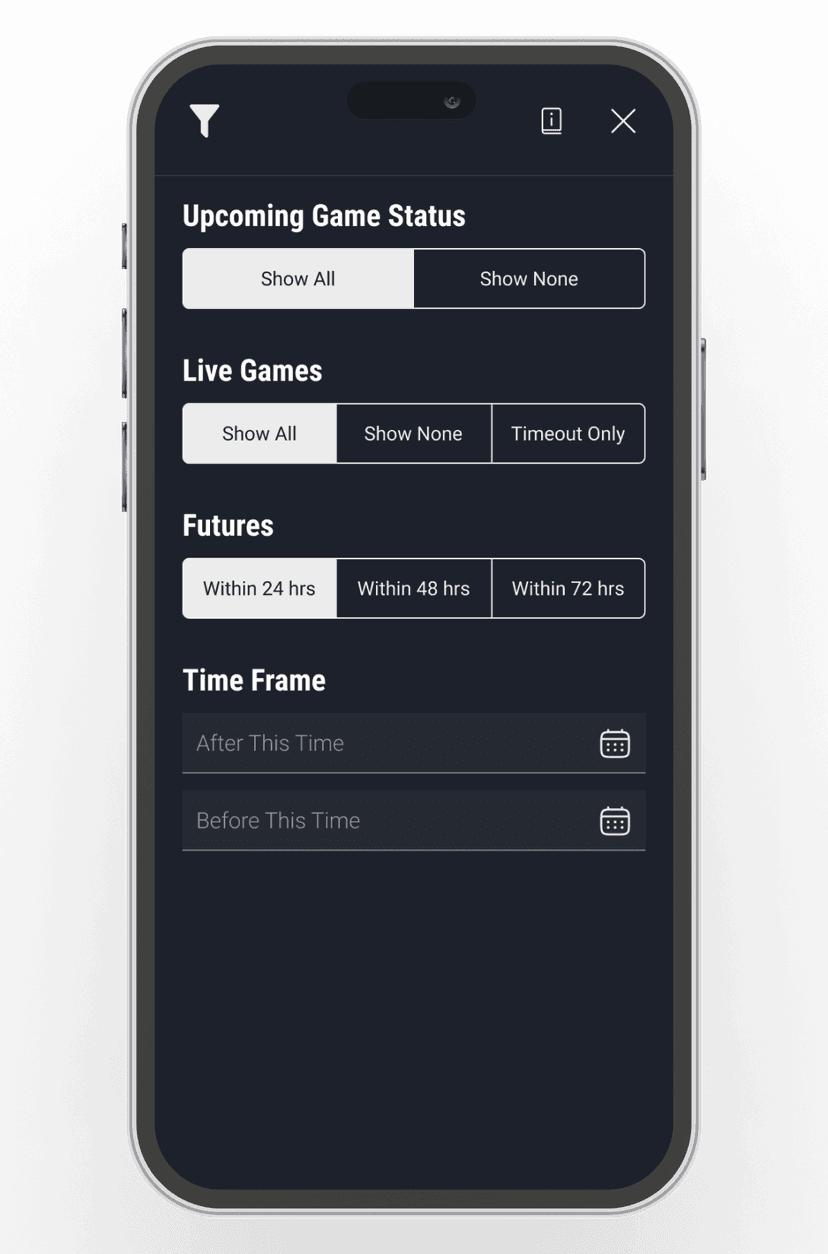
Modern betting platforms are becoming much larger than they were only a few years ago. A single sportsbook can contain thousands of events, dozens of sports, hundreds of market types and constantly changing live opportunities. That variety gives users more choice, but it also creates a practical problem: finding the same types of bets repeatedly can take too much time.
Saved bet filters are emerging as one solution. Instead of rebuilding the same combination of sport, league, market and odds range every time a user opens a sportsbook, platforms can allow those preferences to be stored and reused. The idea is simple, yet it can significantly change how quickly users move from opening an app to finding relevant markets.
Betting menus are becoming harder to navigate
Sportsbooks used to rely on relatively straightforward menus. A bettor selected a sport, chose a competition and opened a match. Modern platforms now combine pre-match markets, live betting, player props, bet builders, statistics, promotions and increasingly personalized sections.
The result is a much denser interface. Recent sportsbook UX analysis shows that operators are putting more attention into faster navigation, personalization and mobile-first design as product complexity grows.
Filters help reduce that complexity by letting users remove information they do not need. A football bettor might only want major European leagues, for example, while another user may mainly follow cricket totals or tennis match winners. Saving those choices removes several steps from every future session.
What a saved betting filter can include
A useful filter does more than remember one sport. Depending on the platform, it can combine several preferences into a single reusable view.
| Filter option | Example preference | Main benefit |
|---|---|---|
| Sport | Cricket | Removes unrelated events |
| Competition | IPL or international matches | Narrows the event list |
| Market | Match winner | Shows familiar bet types |
| Odds range | 1.50–3.00 | Removes unsuitable prices |
| Match status | Live only | Focuses on active events |
| Time range | Next 6 hours | Reduces distant fixtures |
The strongest systems keep these controls easy to understand. Too many filters can become another source of friction, especially on smaller screens. Product designers working with betting and analytics interfaces increasingly focus on grouping filters logically rather than scattering them across multiple menus.
Saved filters reduce repetitive actions
A bettor who follows the same competitions every week often repeats the same navigation process. Open the sportsbook, select the sport, find the league, choose the market and then scan the available events. None of those actions is difficult individually, but repetition makes the experience feel slower.
Saved filters turn that process into a shortcut. One tap can reopen a familiar market view immediately. This matters particularly on mobile devices, where every additional menu and screen transition occupies limited space and interrupts the flow of the session.
The feature also differs from a personalized homepage. Personalization usually decides what the platform thinks a user wants to see. Saved filters give users direct control over what appears, which can make the experience feel more predictable.
Why user-controlled personalization matters
Automated recommendations are becoming common across digital platforms, including sportsbooks. They can highlight relevant events, markets and content based on past activity. However, recommendation systems do not always understand temporary preferences.
A user may normally follow football but spend one weekend watching tennis. An algorithm could interpret that activity as a permanent preference and continue showing tennis markets later. A manually saved filter avoids that problem because the bettor explicitly defines what belongs in the view.
This creates two different forms of personalization:
- Automated personalization predicts what might be relevant.
- Saved filters preserve preferences deliberately selected by the user.
- Temporary filters support one-off searches without changing permanent settings.
- Multiple saved views can cover different sports or betting habits.
Combining these approaches can produce a cleaner interface without forcing every user into the same navigation structure.
Filters become even more useful during live betting
Live betting creates an especially difficult information problem because events and prices change constantly. During busy periods, a platform may display many simultaneous matches alongside dozens of in-play markets.
Current live-betting platforms are increasingly judged on fast odds updates, usable interfaces and the ability to find relevant markets quickly. Saved filters can make that environment easier to manage by showing only specific sports, competitions or live market categories.
For example, someone interested only in live cricket totals could create a dedicated view instead of repeatedly searching through football, tennis and other active events. The platform becomes less like a large catalogue and more like a personal dashboard.
Saved filters can also improve market discovery
There is an interesting balance between convenience and discovery. If a bettor always sees exactly the same markets, useful alternatives may become harder to notice. Good interface design therefore needs to preserve some opportunities for exploration.
A platform might keep the saved view as the main screen while adding a small section for related markets, upcoming events or trending selections. Social discovery features are also appearing inside sportsbooks; FanDuel, for example, introduced a community feed in 2026 that lets users browse and filter shared bets by sport, event and market. That suggests the next generation of sportsbook filters may not simply hide unwanted content. They may also help organize different discovery modes.
The main design challenge is simplicity
More control does not automatically produce a better interface. A sportsbook could technically offer dozens of filters covering market type, price movement, event time, player statistics and many other variables, but presenting all of them at once would overwhelm many users.
The most effective design is likely to keep a few common options visible while placing advanced controls behind an expandable menu. Saved presets can then reduce the need to reopen those controls repeatedly.
A practical structure might include:
- Choose a sport or competition.
- Add one or two relevant market filters.
- Select live or upcoming events.
- Save the combination under a short name.
- Reopen it directly from the sportsbook homepage.
This keeps the initial setup understandable while making repeat visits faster.
Why saved filters may become a standard sportsbook feature
The direction of sportsbook design is increasingly clear. Platforms continue expanding their market coverage while users expect faster, cleaner and more personalized interfaces. Industry analysis in 2026 points to personalization and better connected product experiences as major areas of investment.
Saved bet filters fit naturally into that shift because they solve a simple problem without changing the fundamentals of betting. They reduce repetitive navigation, give users more control over personalization and make large market catalogues easier to manage.
As sportsbooks continue adding more events and betting options, the ability to decide what not to display may become almost as valuable as adding new markets. A good sportsbook interface does not need to show everything at once. Increasingly, the better experience may be the one that helps each user reach the small part of the platform they actually want to see.