

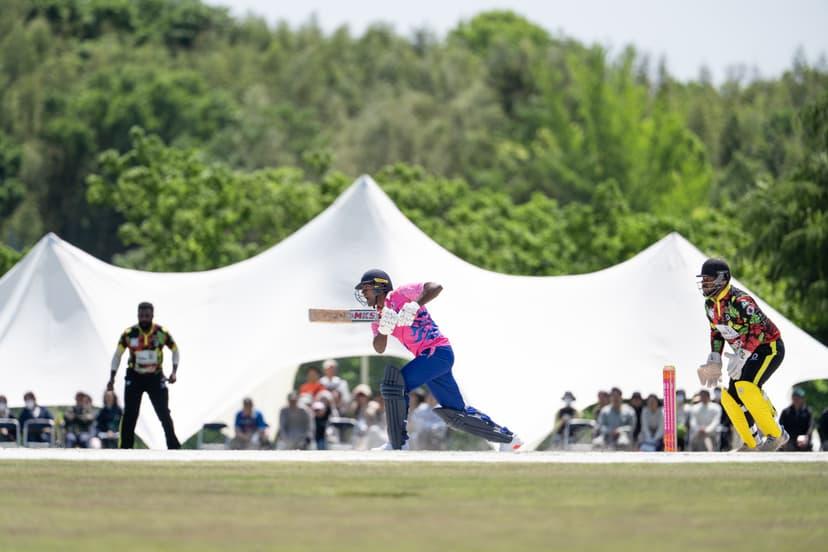
Cricket usually arrives at a major international tournament with its infrastructure already in place. Stadiums have hosted the game for decades, local spectators understand the rules, and domestic competitions provide an established base. The 2026 Asian Games in Japan tell a rather different story. In Nisshin, near Nagoya, international cricket is being played at a venue that until recently was better suited to baseball than boundaries, wickets and T20 internationals.
Korogi Sports Park has been redeveloped specifically to accommodate cricket at the Aichi-Nagoya 2026 Asian Games. Earlier this year, it passed its first major test by hosting matches in the ICC Men’s T20 World Cup East Asia-Pacific Qualifier. Now teams including India, Pakistan, Afghanistan, Nepal, Sri Lanka, Bangladesh, Malaysia and Hong Kong, China are bringing Asian Games cricket to the same ground.
The tournament therefore matters beyond medals. It provides a useful example of how cricket can establish itself in a country where purpose-built grounds remain scarce, without waiting decades for an entirely new stadium network to appear.
A Baseball Facility Has Become an International Cricket Ground
Japan has an obvious infrastructure problem when it comes to expanding cricket. Baseball is deeply established, while cricket remains a comparatively small sport. Building large cricket-only stadiums before there is sufficient demand would be expensive and difficult to justify. Nisshin has taken another route.
The facility at Korogi Sports Park was remodelled from an existing baseball venue roughly 20 kilometres from central Nagoya. Work was completed in March 2026, with a hybrid cricket square forming an important part of the conversion.
That does not mean a baseball field can become a cricket ground simply by adding a pitch. Cricket requires appropriate dimensions, a suitable central playing surface, practice facilities, safe boundary areas and infrastructure capable of supporting teams, officials and spectators.
The redevelopment nevertheless demonstrates how existing sports facilities can provide a starting point.
| Feature | Korogi Sports Park |
|---|---|
| Location | Nisshin, Aichi Prefecture |
| Previous use | Baseball-oriented sports facility |
| Main conversion | International cricket ground |
| Pitch | Hybrid cricket square |
| First major 2026 test | T20 World Cup EAP Qualifier |
| Asian Games format | T20 |
| Regular qualifier capacity | Around 1,000 |
| Asian Games capacity plan | Around 2,000 with temporary seating |
The venue is now the second facility in Japan with a natural-grass pitch meeting the requirements for international competition.
The First Test Came Before the Asian Games
Rather than opening Korogi Park directly into one of Asia’s largest sporting events, organizers had an opportunity to test it earlier. In May, the ground hosted six matches during the ICC Men’s T20 World Cup East Asia-Pacific Qualifier. Nine teams took part in what the ICC described as the largest men’s East Asia-Pacific qualifier staged to date, with games split between Nisshin and the more established Sano International Cricket Ground.
That tournament gave organizers a chance to see how the new venue handled international teams, spectators and match operations before the Asian Games arrived. It also gave the ground something more valuable than a ceremonial opening: actual cricket.
A new venue can look impressive in photographs while still revealing practical problems once matches begin. Players need reliable practice areas, officials need appropriate working spaces, spectators need clear access and the playing surface has to remain consistent throughout repeated fixtures. Hosting a qualification tournament months before the Asian Games provided a real-world rehearsal.
Cricket Is Happening in Nagoya Right Now
The Asian Games have now turned that rehearsal into a much larger international stage. Men’s competition began on September 24, when Afghanistan defeated host nation Japan by 48 runs at Korogi Park. Japan had been competitive during parts of the match, reaching 53/3 while chasing 130, before Afghanistan’s bowling attack reduced the hosts to 81 all out.
Nepal subsequently produced one of the notable early results of the competition by defeating Afghanistan, while Malaysia and Hong Kong, China also collected group-stage victories. The tournament has already demonstrated another reality of cricket infrastructure: weather matters.
On September 28, persistent rain caused both scheduled men’s quarter-finals to be abandoned without play. Pakistan’s match against Hong Kong, China and India’s meeting with Afghanistan could not begin, sending the higher-seeded Pakistan and India directly into the semi-finals.
It was an unfortunate day for spectators, but also a reminder that establishing cricket infrastructure involves considerably more than constructing a pitch. Drainage, scheduling flexibility and local climate all influence how effectively a venue can host tournaments.
Japan Is Getting Matches It Rarely Had Before
The ground itself is only one part of a busier year for Japanese cricket. Japan hosted the East Asia-Pacific qualifier in May and remained in contention on the pathway toward the 2028 Men’s T20 World Cup. September then brought an even bigger sequence of matches around the Asian Games.
The Japanese men’s team faced Hong Kong, China in two T20Is before meeting India in a historic fixture at Sano on September 22. The match formed part of the broader “Sport 75” initiative promoting sporting exchanges between India and Japan. Two days later, Japan began its Asian Games campaign against Afghanistan in Nagoya.
For an emerging cricket nation, this concentration of meaningful international fixtures can matter as much as a single high-profile exhibition. Players gain experience against stronger opposition, organizers repeat the process of running international matches, and local audiences have more than one opportunity to encounter the sport.
The progression in 2026 has looked something like this:
- international pathway cricket arrives at the new Nisshin ground;
- the venue is tested across multiple matches;
- Japan plays stronger international opposition at home;
- Asian Games cricket brings leading Asian teams to the country;
- the infrastructure remains available after the tournament ends.
That final point will determine much of the long-term value.
Why T20 Fits an Emerging Cricket Market
The Asian Games use the T20 format, which is particularly suitable when cricket is being presented to spectators who may not already follow the sport. A Test match can last five days. An ODI occupies most of a day. T20 compresses each innings into 20 overs, giving new spectators a complete contest within a much shorter window.
It also produces a relatively easy structure to explain. Each side receives 120 legal deliveries, wickets limit the batting team, and the side scoring more runs wins. Someone watching cricket for the first time does not need to understand every tactical detail before following the basic contest.
That matters in Japan. The goal is not simply to provide existing cricket supporters with another venue; international events can expose the game to people who may previously have encountered it only briefly. T20 cannot solve every development challenge, but it reduces one barrier: time.
Converting Existing Venues Could Matter Beyond Japan
The most interesting part of the Nisshin project may ultimately be its adaptability. Cricket’s expansion into new markets often creates a difficult infrastructure equation. Governing bodies want more matches, but cities may hesitate to build specialist venues for a sport that does not yet attract large crowds. Without venues, however, it becomes harder to stage the matches needed to grow those crowds.
Using or adapting existing sports infrastructure can help break that cycle. Japan is particularly interesting because baseball facilities are widespread. The two sports have major differences, and conversion is not automatic, but some existing spaces can potentially provide the land and supporting infrastructure from which a cricket facility can be developed.
The same principle can apply elsewhere. Emerging cricket countries do not necessarily need to begin with 30,000-seat stadiums. Smaller international-standard grounds can host qualifiers, youth tournaments, bilateral series and regional competitions while the audience develops.
A Venue Is Useful Only If Cricket Stays After the Event
Major multi-sport competitions sometimes leave behind impressive facilities that struggle to find a purpose once the closing ceremony is over. That is the obvious risk for any new sporting infrastructure. Korogi Park has one advantage: cricket was already played there before the Asian Games.
Its use during the East Asia-Pacific qualifier shows that the ground can serve ICC pathway competition rather than existing solely for one event. Japan’s continuing pursuit of T20 World Cup qualification also gives the national association a reason to seek more competitive matches.
The next step is therefore less glamorous than hosting India or Pakistan. Japan needs regular domestic use, international fixtures, youth development and opportunities for local players to train and compete on appropriate surfaces. If those pieces continue to grow, the Asian Games will have done more than bring cricket to Nagoya for a few weeks.
Japan’s Cricket Experiment Is Worth Watching
Nobody should mistake one converted ground for evidence that cricket has suddenly become a mainstream Japanese sport. Baseball remains vastly more established, and Japan’s cricket community is still developing its player base, audience and facilities. What has changed in 2026 is the scale of opportunity.
A remodelled baseball facility has hosted a T20 World Cup pathway event and is now welcoming Asian Games teams. Japan has played significant home internationals, including a historic match against India, while local players are gaining experience against opposition they rarely encountered at home in previous years.
That makes Nagoya’s new cricket ground more interesting than another tournament venue. It is a practical experiment in how cricket can expand where traditional infrastructure does not already exist.
The Asian Games will finish. The temporary stands will come down. The more important question begins afterward: how often will players return to the middle? If Korogi Park continues hosting international qualifiers, domestic cricket and new generations of Japanese players, converting a baseball facility may prove to have created something much more permanent than an Asian Games venue.