

The Men’s Cricket World Cup is returning to Africa in 2027, but the change of scenery will not be the only thing that feels different. The ICC has now revealed the tournament schedule and confirmed a format that asks teams to navigate as many as three competitive stages before reaching the semi-finals. Instead of moving directly from conventional groups into knockout cricket, the 14-team competition will begin with a small qualifying Super Series, expand into two six-team groups and then narrow into a seven-team round robin known as the Super 7.
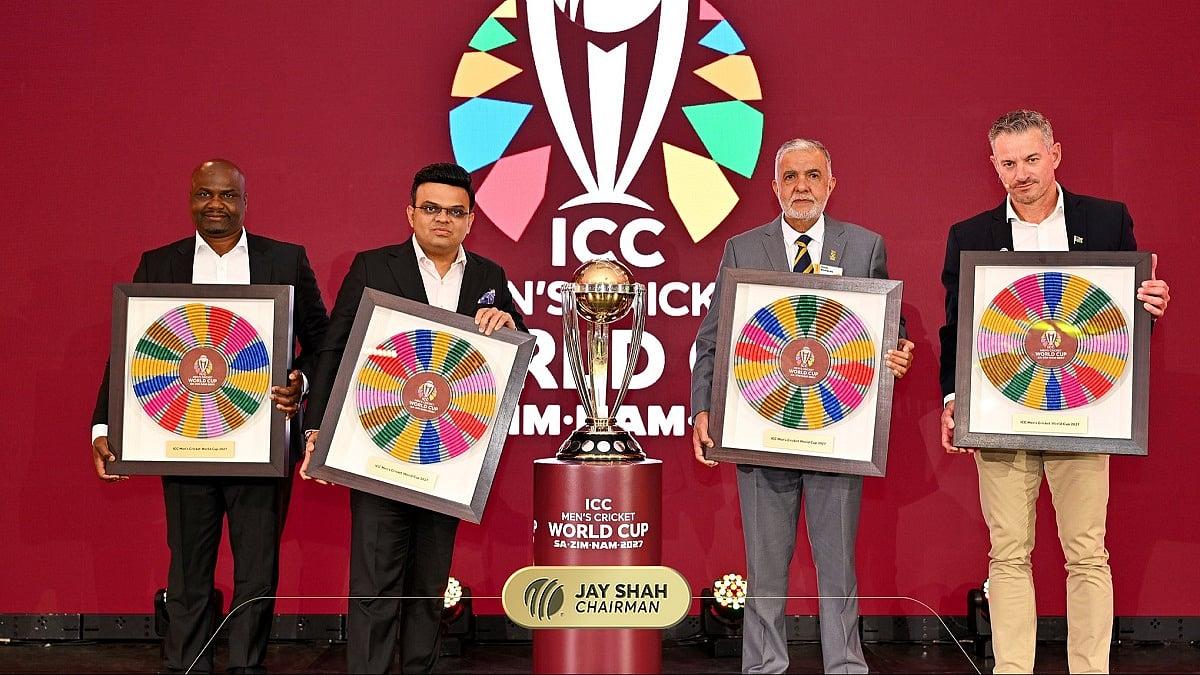
The schedule was unveiled in Cape Town on October 1, 2026, exactly one year before the main tournament period. South Africa, Zimbabwe and Namibia will jointly stage 57 matches across 12 venues between October 2 and November 21, 2027, bringing the men’s ODI World Cup back to Africa for the first time since 2003. Namibia will also host senior Men’s Cricket World Cup matches for the first time. With Australia defending the title, India returning after reaching the 2023 final and several qualification places still to be settled, understanding the format is almost as important as knowing the fixture list.
The World Cup Actually Starts Before the Main Groups
The first unusual feature appears immediately. Fourteen teams will qualify for the World Cup, but only 12 places exist in the main Group Stage. The three lowest-ranked teams emerging from the 2027 World Cup Qualifier will therefore travel to Namibia for a preliminary Super Series beginning on October 2.
Those three sides will play a round robin against one another, producing three matches in total. Only the team finishing first advances to the Group Stage, while the other two leave the competition without entering the main groups. The winner of the World Cup Qualifier, by contrast, receives a direct place in the Group Stage alongside the ten teams that secured direct qualification.
That structure creates a striking difference in the routes teams can take through the same tournament. A direct qualifier begins its World Cup in the groups, whereas a lower-ranked qualifier may already have played two high-pressure matches before reaching that point. The Super Series is therefore short, but its consequences are enormous: two of the 14 participating teams will be eliminated before most of the tournament’s biggest names have played their first game.
| Stage | Teams | Matches | Who advances? |
|---|---|---|---|
| Super Series | 3 | 3 | 1 team |
| Group Stage | 12 | 30 | 7 teams |
| Super 7 | 7 | 21 | 4 teams |
| Semi-finals | 4 | 2 | 2 teams |
| Final | 2 | 1 | Champion |
This arrangement also gives Namibia an important role from the opening week. Windhoek is not merely another stop later in the tournament; it becomes the location where the final Group Stage participant will be decided.
Two Groups of Six Create the Main World Cup Field
Once the Super Series is complete, 12 teams move into two groups of six. Group A currently contains India, Australia, Pakistan, Afghanistan and Zimbabwe alongside Qualifier A. Group B contains New Zealand, South Africa, Sri Lanka, England and Bangladesh alongside Qualifier B.
Each team plays every other team in its group once, creating five Group Stage matches per side and 30 fixtures overall. The top three from each group progress automatically, but the seventh Super 7 position introduces another layer: the better-performing fourth-placed team across the two groups also advances.
That means finishing fourth does not necessarily end a team’s tournament. Two fourth-placed sides effectively compete across separate groups for one remaining position, making net run rate, points and other tournament tiebreakers potentially important even when a team has fallen outside its group’s conventional qualification places.
The schedule has also placed several major fixtures early. Defending champions Australia face India at Newlands in Cape Town on October 7, recreating the matchup from the 2023 final. South Africa begin against New Zealand the following day, while India and Pakistan meet at the Wanderers in Johannesburg on October 10. Zimbabwe, returning to the men’s ODI World Cup after missing the previous two editions, will play its opening Group Stage fixture in Bulawayo.
The New Super 7 Is Where the Tournament Becomes Different
Reaching the second phase does not place a team only a few victories from the final. Instead, the seven surviving sides enter another complete round robin. Every team plays the other six once, generating 21 additional matches before the semi-finalists are determined.
Crucially, points from the first Group Stage are not carried into the Super 7. Teams begin the phase with a fresh table, meaning an outstanding opening group provides qualification but no numerical advantage in the next stage. A side can dominate its first five matches and still need to perform consistently across another six games to reach the semi-finals.
The structure produces several consequences for teams and supporters:
- qualification requires sustained performance rather than one short successful group run;
- major teams can potentially meet again during the Super 7;
- every qualifier receives six matches in the second phase;
- early Group Stage results do not provide points for the Super 7 table;
- only the top four after the full Super 7 schedule reach the semi-finals.
The ICC has also pre-seeded several teams into Super 7 positions for scheduling purposes. India, Australia and Pakistan occupy A1, A2 and A3 slots, while New Zealand, South Africa and Sri Lanka hold B1, B2 and B3 positions; England has the AB4 slot. These designations help organisers map possible fixtures and venues before qualification is known, although a non-seeded team that finishes above a seeded side can assume that team’s allocated position.
For travelling supporters, this matters because the later schedule does not have to remain completely unknown until the groups finish. Potential routes through the tournament can be understood earlier, even though actual qualification still depends on results.
A Long Route Makes Consistency More Valuable
The 2027 structure substantially reduces the possibility that a leading side can reach the knockouts after only a small number of meaningful matches. A team entering directly into the Group Stage must play five games there and another six if it reaches the Super 7. A Super Series participant that goes all the way could play even more before the semi-final.
This creates a different competitive problem from a tournament built around a short group followed quickly by knockouts. Squads will need to cope with changing venues, travel across three countries, workload management and different opposition over several weeks. One poor result may be recoverable, but maintaining form over such a long sequence becomes increasingly important.
The format could also create unusual strategic situations near the end of the first groups. Because one fourth-placed team progresses, a side that can no longer reach the top three may still have a realistic route into the Super 7. At the same time, qualification for the next phase merely resets the competitive challenge because no points are carried forward.
There is a trade-off. More round-robin cricket gives strong teams additional opportunities to recover from an upset, potentially reducing the impact of a single surprise result. On the other hand, it also makes it difficult to survive the tournament through one brief period of exceptional form. Teams have to keep producing results.
Twelve Venues Spread the Tournament Across Southern Africa
The tournament’s scale becomes clearer when looking beyond the format. Eight venues are located in South Africa, three in Zimbabwe and one in Namibia. Host cities include Johannesburg, Cape Town, Durban, Tshwane, Gqeberha, Bloemfontein, Paarl and KuGompo City in South Africa; Harare, Bulawayo and Victoria Falls in Zimbabwe; and Windhoek in Namibia.
Victoria Falls provides one of the most distinctive additions. Zimbabwe is scheduled to face India at the Mosi-oa-Tunya Stadium there during the Group Stage, bringing World Cup cricket to a setting far removed from the large metropolitan grounds normally associated with major ICC events.
Cape Town and Tshwane will stage the semi-finals on November 17 and 18. Johannesburg then hosts the final at the Wanderers on November 21, meaning the same ground selected for the India-Pakistan Group Stage fixture will ultimately decide the world champion.
For supporters considering travelling between matches, geography will matter almost as much as the fixture list. This is a three-country tournament covering substantial distances, so following a team through several stages could require considerably more planning than attending matches concentrated around one city.
The Ticket Ballot Changes the Race to Attend Big Matches
The schedule announcement was accompanied by another important development for supporters: the global ticket ballot opened on October 1, 2026. Entry remains available until 23:59 SAST on November 21, and the system is deliberately not first-come, first-served.
Fans can apply for multiple matches and request up to four tickets for an individual fixture. Where demand exceeds supply, successful applicants will be selected through a randomised ballot. Registration itself is free, and no ticket payment is taken when entering; successful applicants are later given a defined purchasing window.
That system is particularly relevant for fixtures likely to attract demand far beyond stadium capacity, including India against Pakistan. It removes the need to race through a checkout immediately when sales open, although entering the ballot does not guarantee the right to purchase. With the schedule now public, supporters can begin comparing possible team routes rather than applying blindly. The pre-seeded Super 7 structure also provides some indication of where major teams could play if they progress, although actual qualification remains uncertain.
World Cup 2027 Will Reward Teams That Survive the Long Game
The headline numbers — 14 teams, 57 matches and 12 venues — only partly explain how different the 2027 Men’s Cricket World Cup will feel. The more important change is the route through those matches. A preliminary Super Series removes two teams, two groups of six reduce the field to seven, and another complete round robin determines the four semi-finalists.
For spectators, that means more opportunities to watch leading teams and the possibility of major rivalries appearing more than once. For players, it means there is almost nowhere to hide over the course of the tournament. A team may recover from one poor afternoon, but reaching Johannesburg on November 21 will require consistency across several stages and potentially more than a dozen matches.
The World Cup is still a year away, and four qualification positions remain to be decided. What is no longer uncertain is the structure awaiting those teams. In 2027, becoming world champion will not be about surviving one group and then winning a few knockout matches. The route through Southern Africa will be a tournament of endurance long before the semi-finals begin.