

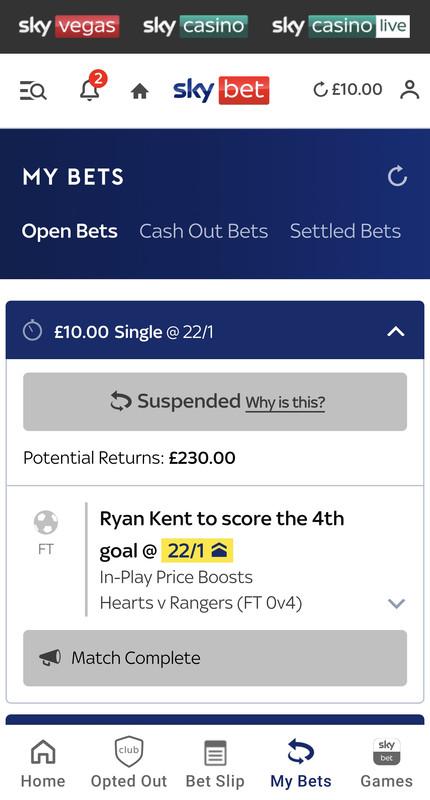
Anyone who follows live betting has probably seen a market suddenly disappear or become unavailable just as something important happens in a match. For years, platforms often handled this with a simple “suspended” label and very little explanation. That approach worked technically, but it left users guessing about whether the market had closed permanently, whether their connection had failed or whether betting would resume a few seconds later.
Modern betting platforms are starting to treat suspension messages as part of the overall user experience rather than a background technical process. Clearer notices, event-specific explanations and more visible reopening signals are helping users understand what is happening without repeatedly refreshing the page or navigating away from the event.
Why betting markets become suspended
A suspended market is not necessarily a sign that anything has gone wrong. In live sports, odds can change extremely quickly, and bookmakers may temporarily stop accepting bets while new information is processed.
Common triggers include:
- goals, wickets, points or other major scoring events;
- penalties, red cards and significant disciplinary decisions;
- video reviews and referee decisions;
- injuries that materially affect the market;
- the end of a period, set, quarter or innings;
- sudden changes in the available live data feed;
- unusually rapid movements in prices.
The exact reason depends heavily on the sport. A football goals market may pause immediately after a dangerous attack, while cricket markets can be suspended between deliveries or when a wicket is being reviewed. Tennis platforms may briefly stop selected markets during crucial points. The suspension itself is therefore normal. What is changing is the amount of information users receive while it happens.
From generic messages to contextual explanations
Older sportsbook interfaces often relied on one status message for almost every interruption. Users saw “market suspended” regardless of the underlying reason.
A more informative interface can provide several levels of context.
| Situation | Basic interface | More informative interface |
|---|---|---|
| Goal scored | Suspended | Suspended while goal is confirmed |
| VAR review | Suspended | Market paused during VAR review |
| Cricket wicket | Suspended | Prices updating after wicket |
| End of quarter | Closed | Market updating for next quarter |
| Data interruption | Unavailable | Live data temporarily unavailable |
| Normal repricing | Suspended | Odds updating |
These small differences matter because they answer the first question a bettor usually has: “What just happened?” Users may still have to wait for a market to reopen, but they no longer need to interpret an unexplained status message.
Live sports make clarity more important
Pre-match betting usually changes at a manageable pace. Live betting is different. A match can move from one important event to another within seconds, and several markets may close, reopen and reprice during that period. That speed creates a difficult interface problem. Platforms need to protect the accuracy of their prices while also preventing the page from feeling unreliable.
Clear market states help separate three very different situations:
- A market is temporarily paused and should return.
- A market has finished and will not reopen.
- A technical or data problem is preventing betting.
When all three situations look identical, users may refresh unnecessarily or assume the sportsbook is malfunctioning. More specific messaging reduces that uncertainty.
Reopening indicators are becoming useful too
Explaining why a market stopped is only half of the problem. Users also want to know whether it is likely to return. Some interfaces now keep suspended markets visible rather than removing them completely. The odds may be greyed out while the market title remains in place, making it easier to see when betting resumes.
This is particularly useful on events containing dozens or even hundreds of markets. If a market disappears completely, a user may need to search for it again after prices are updated. Keeping its position stable makes the transition considerably smoother.
Platforms can also use subtle status changes such as:
- “Updating odds”
- “Awaiting confirmation”
- “Temporarily suspended”
- “Market closed”
- “Reopening shortly”
The purpose is not to predict an exact reopening time. It is simply to make the current state easier to understand.
Different sports require different suspension logic
There is no single suspension system that works equally well across every sport. The rhythm of the event changes what information is useful.
| Sport | Typical suspension trigger | Useful user information |
|---|---|---|
| Football | Goal or VAR review | Whether the scoring event is being confirmed |
| Cricket | Wicket or boundary | Whether prices are updating between deliveries |
| Tennis | Important point | Whether the next-point market will reopen |
| Basketball | Foul or timeout | Whether in-play markets are being repriced |
| Ice hockey | Goal or penalty | Whether the market is awaiting event confirmation |
| Baseball | End of at-bat or inning | Whether inning markets have closed or are updating |
That is one reason contextual interfaces are becoming more common. Instead of treating every live event in the same way, the platform can adapt status messages to the structure of the sport.
Market transparency can reduce unnecessary actions
Poor suspension messaging creates several predictable behaviours. Users refresh the page, switch between event screens, reopen the bet slip or repeatedly tap odds that are temporarily unavailable. None of those actions improves the betting experience. They happen because the interface has not clearly communicated what is happening.
A good status system removes much of that friction. The bettor can see that a market is paused because a goal is under review, for example, and simply wait for the result instead of assuming the app has stopped responding. This becomes even more important on mobile devices, where constant navigation between screens can quickly become frustrating.
Clearer information does not remove uncertainty
Even a well-designed interface cannot always tell users exactly when a market will return. Live betting depends on incoming sports data, trading decisions and confirmation of events, so some suspensions may last only seconds while others result in the market being closed permanently.
Platforms therefore have to avoid providing false precision. A message such as “reopening shortly” may be useful when the system genuinely expects the market to return, but giving an exact countdown would be misleading if the timing depends on an external event. The best interfaces explain what is known without pretending to know more than they do.
Why this small feature matters
Suspended betting markets may seem like a minor design detail, yet they appear at exactly the moments when users are paying the most attention to an event. A confusing message during a decisive goal, wicket or referee review can make an otherwise polished platform feel unreliable.
By keeping markets visible, explaining why they are paused and distinguishing temporary suspensions from permanent closures, betting platforms can make live events easier to follow without changing the underlying betting mechanics.
As online betting interfaces continue to mature, improvements may increasingly come from these smaller moments. Faster navigation and better statistics remain important, but simply telling users what is happening at the right time can make just as much difference.