

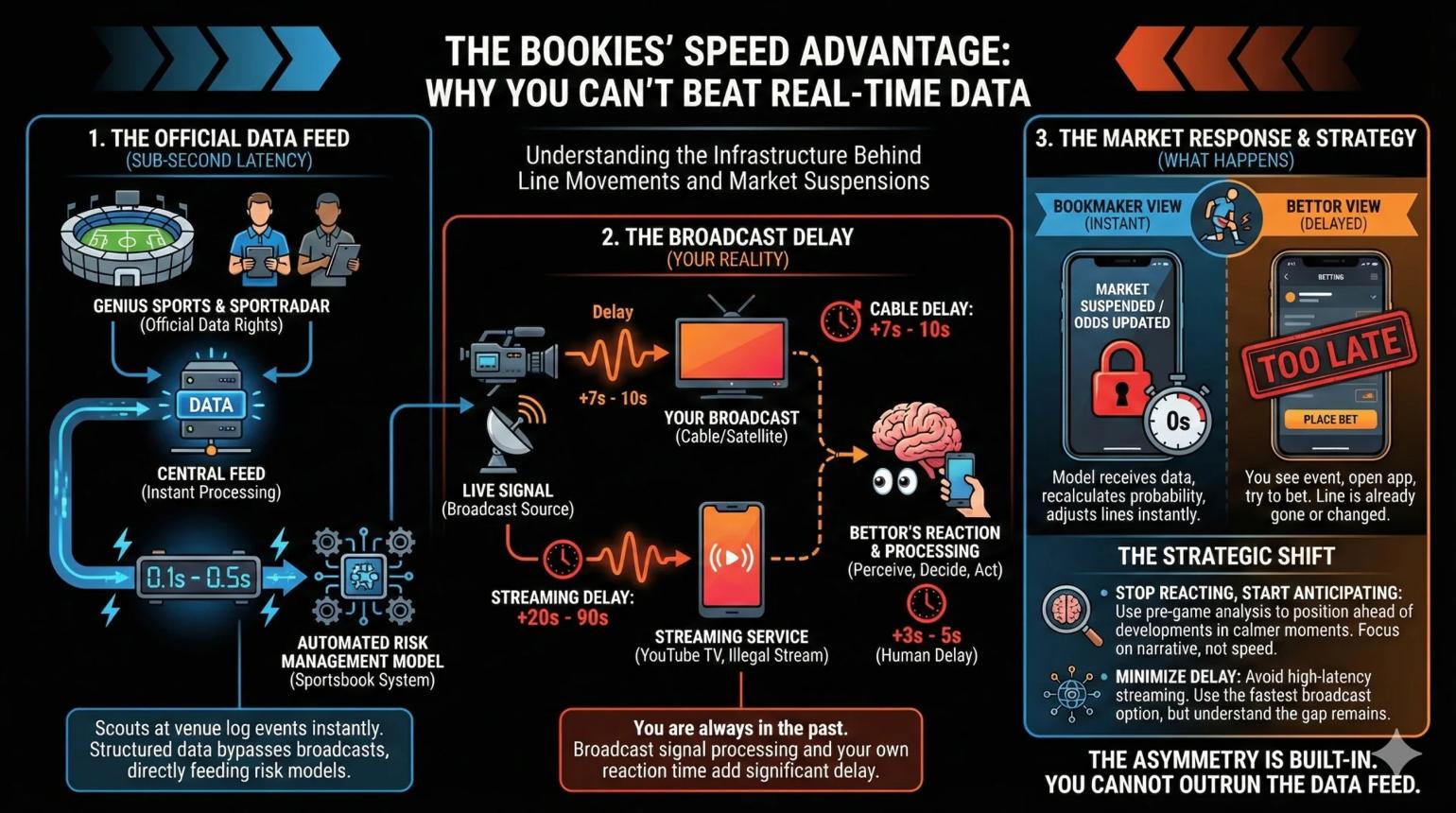
Anyone who has placed a live sports bet has probably encountered a short wait between pressing the confirmation button and seeing the wager accepted. For years, that delay was treated as a fairly simple part of in-play betting: the sportsbook waited a few seconds, checked that the market was still valid and then either accepted or rejected the wager.
That model is becoming more sophisticated. Instead of applying approximately the same delay to every live selection, modern sportsbook technology can adjust waiting periods according to the individual bet, market and situation unfolding on the field. The goal is to remove unnecessary friction when risk is relatively low while retaining additional protection when an event could immediately change the value of a selection.
The trend became particularly visible after the 2026 FIFA World Cup. Kambi said its dynamic live delay technology helped reduce live betting delays by more than 40% between August 2025 and July 2026 across the Premier League and World Cup. The same tournament was also the company’s first World Cup traded entirely by AI, processing more than 100 million bets across 104 matches.
Why Do Live Bets Need a Delay at All?
A live sportsbook operates in an environment where information can change prices within seconds. Consider a cricket match. A sportsbook may display a market immediately before the bowler begins a delivery. During the next few seconds, the batter could hit a six, lose a wicket or take no run at all. Each outcome can affect the probability behind multiple markets.
Football creates the same problem around goals, penalties, red cards and dangerous attacks, while tennis prices can move after almost every point. The sportsbook therefore needs to prevent a wager from being accepted using information that has already become outdated. A short delay provides time for the betting system to compare the requested wager with the latest event data and market state before final acceptance.
Fixed Delays Are Simple but Inefficient
The traditional approach is relatively easy to understand: apply a standard delay to a category of live bets. If the platform uses a five-second delay, for example, many wagers in that category may wait approximately five seconds before being processed.
The problem is that not every bet carries the same informational risk. A selection directly connected to the next few seconds of play can become outdated almost immediately. Another market covering a much broader outcome may be less sensitive to the same moment.
Treating both situations identically can introduce unnecessary waiting.
| Approach | How it works | Main limitation |
|---|---|---|
| Fixed delay | Similar wait applied broadly | Low-risk bets may wait unnecessarily |
| Market-based delay | Delay varies by market category | Still treats many situations alike |
| Dynamic delay | Wait changes according to current risk | Requires more sophisticated technology |
| Bet-level delay | Individual wager receives appropriate delay | Depends heavily on real-time data and models |
Dynamic systems attempt to make that process more precise.
What Is a Dynamic Live Betting Delay?
A dynamic delay adjusts the waiting period rather than treating it as one permanent number. The sportsbook can consider the market being selected, the current stage of the event, incoming sports data and the probability that something important is happening at that moment. A relatively stable situation might allow a wager to move through the process quickly. A high-risk moment can justify a longer delay or temporary suspension.
This means two users placing different bets on the same match do not necessarily need identical waiting periods. Kambi describes its current system as setting bespoke live delays at an individual bet level. According to the supplier, this approach helped reduce friction during the Premier League and 2026 World Cup while maintaining the controls needed for in-play trading.
Cricket Shows Why Context Matters
Cricket is a useful example because the informational importance of a few seconds changes throughout a match. A bet placed while players are preparing between deliveries carries a different immediate context from one submitted as a bowler starts the run-up. Likewise, some markets react directly to the next ball while others depend on the result of an innings or entire match. A dynamic system can potentially distinguish between those situations.
The same principle applies to different cricket markets:
- next-ball outcomes can be extremely time-sensitive;
- current-over markets depend on a short sequence of play;
- player totals develop over a longer period;
- innings markets have a broader time horizon;
- match-result markets may remain open for hours.
Applying exactly the same delay to every category would ignore those differences.
Dynamic Delays Are Not the Same as Acceptance Timers
The two ideas are related but solve different problems. An acceptance timer is primarily a user-interface feature. It tells the bettor that the sportsbook is processing a wager and helps explain why confirmation is not instantaneous. A dynamic delay belongs deeper inside the betting system. It determines how much waiting or verification is appropriate for a particular wager.
The distinction can be summarized simply:
| Feature | Main purpose |
|---|---|
| Acceptance timer | Communicate processing status to the user |
| Dynamic live delay | Determine how much delay a wager requires |
| Market suspension | Stop betting temporarily |
| Odds update | Reprice a market after new information |
| Bet confirmation | Show whether the wager was finally accepted |
A platform can use both an intelligent delay system and a clear acceptance interface at the same time.
Faster Does Not Mean Removing Every Delay
Reducing live betting delay sounds straightforward from a user-experience perspective. Nobody wants to wait longer than necessary. However, making every live bet instantaneous would create another problem.
Sportsbooks receive event data from different sources and need time to process changes. Video broadcasts can also reach viewers at different speeds depending on the channel, streaming platform, connection and geographic location.
If the betting system continues accepting an outdated price after a decisive event has already occurred, users with faster information could gain an advantage over the sportsbook and other bettors.
The objective is therefore not zero delay. It is appropriate delay. A well-designed system should avoid making users wait when there is little reason to do so while reacting quickly when the informational risk rises.
AI Is Making the Decision More Granular
The development of dynamic delays is connected with broader automation inside sportsbook trading. Kambi reported that its 2026 World Cup was traded entirely by AI. The system handled pricing, offer creation, liability management and settlement across 104 matches and more than 100 million bets, with the supplier reporting zero downtime during the tournament. The significance for live betting is scale.
A major event can contain enormous numbers of markets and combinations. Kambi said live Bet Builder usage during the World Cup was seven times higher than in 2022, with live Bet Builders representing 22% of live wagers compared with 3% four years earlier.
Managing that level of complexity manually becomes difficult. Automated systems can evaluate far more situations simultaneously, including whether a particular wager requires additional delay.
More Markets Make Latency Harder to Manage
Modern sportsbooks no longer offer only match winner, totals and a few basic player markets. Major events can include hundreds or thousands of possible selections, while Bet Builders create combinations that may involve several correlated outcomes. This makes live pricing more complicated. During the 2026 World Cup, Kambi reported that player propositions appeared in 65% of Bet Builders, compared with 25% during the 2022 tournament.
A delay system therefore has to operate in an environment where wagers themselves are becoming more individualized. A fixed waiting period is relatively crude when one bettor is selecting a straightforward match market and another is creating a multi-selection live combination involving several player outcomes. Dynamic processing fits that increasingly personalized product structure.
Better Delays Can Make Live Betting Feel More Responsive
From the user’s perspective, the underlying risk model is largely invisible. What matters is whether the platform feels responsive. Waiting several seconds for every selection can make live betting feel disconnected from the event, particularly during sports where play changes rapidly. Removing even a small amount of unnecessary waiting can make navigation from selection to confirmation feel smoother.
The improvement becomes more noticeable when a bettor places several wagers during the same event. However, consistency remains important. A fast system that provides no explanation when a wager suddenly takes longer can still feel unreliable. That is why dynamic delays work best alongside clear status information.
Suspensions Still Have a Role
Dynamic delays do not eliminate market suspensions. There are moments when continuing to accept bets would make little sense regardless of how sophisticated the delay model becomes.
A football market may close during a penalty decision. Cricket selections may suspend after a wicket while prices are recalculated. Tennis markets commonly pause around the conclusion of individual points.
The difference is that sportsbooks can become more selective about when waiting is enough and when complete suspension is necessary. That creates several possible responses to live events rather than one universal rule:
- accept immediately when risk is low;
- apply a short delay when verification is useful;
- increase the delay during a sensitive moment;
- reprice the selection if conditions change;
- suspend the market when reliable acceptance is temporarily impossible.
The bettor may see only a few interface states, but the technology underneath can make a much more detailed decision.
The Best Delay May Be the One Users Barely Notice
Sportsbook technology often receives attention when a new feature appears on screen. Dynamic live delay is different because successful implementation can make part of the interface less noticeable.
Users do not necessarily need to know that one wager was assigned a shorter delay than another. They simply experience a platform that responds quickly when it can and takes additional time when circumstances require it.
The World Cup data provides a useful indication of how significant that optimization can become. A reduction of more than 40% in live betting delay across the period measured by Kambi is not simply a cosmetic interface change; it reflects a different approach to deciding how individual wagers move through a live sportsbook.
As live markets expand, Bet Builders become more detailed and automated trading handles increasingly large volumes, a single fixed waiting period makes less sense. The direction is toward delays that respond to the actual wager and the actual moment. For bettors, the result should be straightforward: less unnecessary waiting without pretending that real-time sports betting can operate safely with no delay at all.