

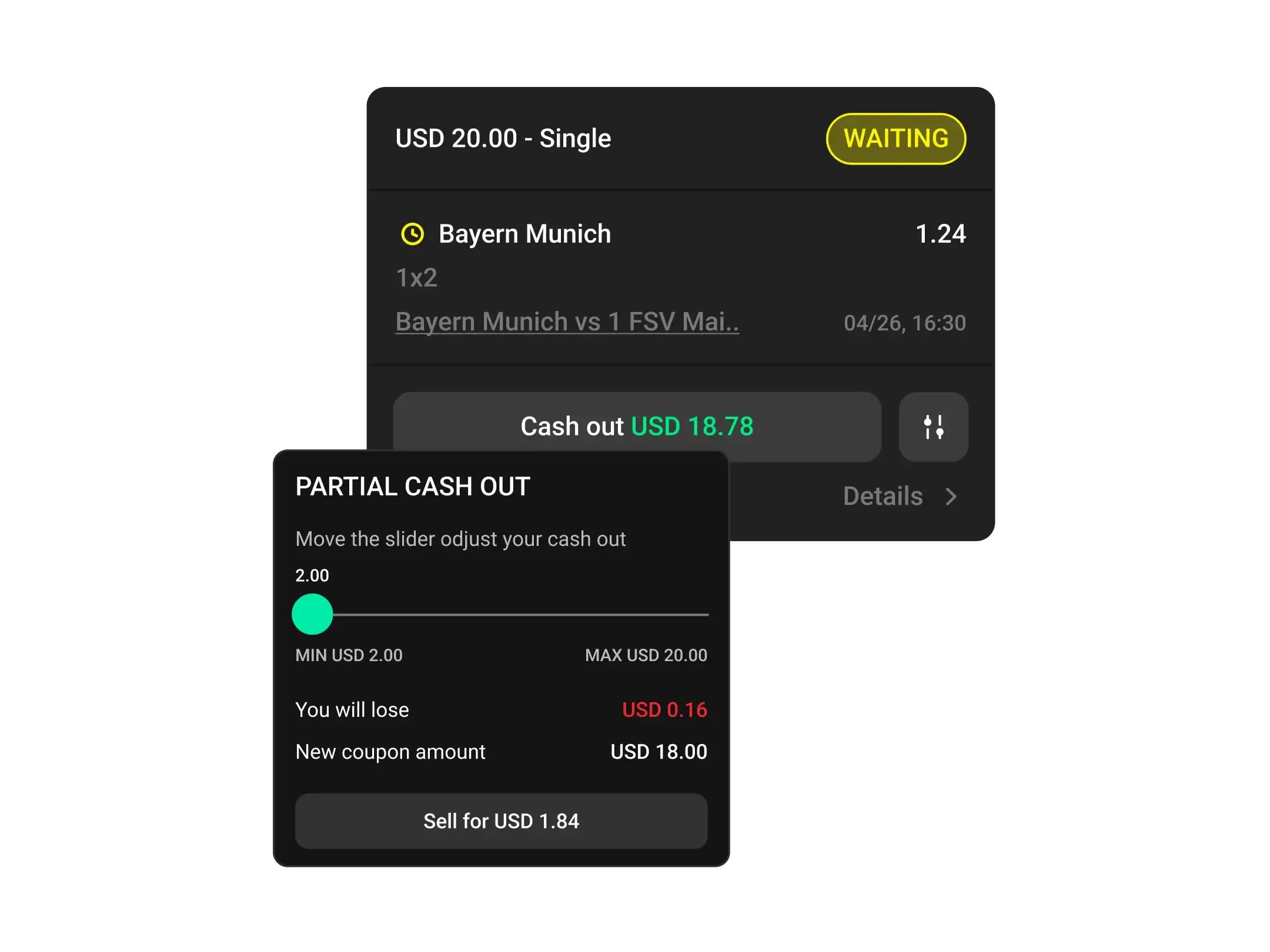
Cash-out originally presented bettors with a fairly simple decision: keep an active wager running or accept the amount currently offered and close it. Partial cash-out introduces a middle option. Instead of settling the entire position, a user can close part of it while leaving the remainder active until the event develops further.
That small change creates a surprisingly different experience. The bettor no longer has to choose between complete commitment and complete exit, while the interface has to explain exactly how much is being settled, how much remains active and what happens to the potential return. As betting platforms add more live markets and complex bet types, partial cash-out is becoming an interesting example of how a familiar feature can gain another layer of control without requiring an entirely new wagering format.
Partial cash-out splits one decision into two
Consider a simple example. A bettor places a wager and later receives a cash-out offer after the event has moved in their favor. With traditional full cash-out, accepting the offer ends the wager completely. Whatever happens next no longer affects it.
Partial cash-out works differently. The user might settle 40% of the position and leave the remaining 60% active. Part of the value becomes fixed, while the unresolved portion continues according to the original market and subsequent event outcome.
The precise implementation varies between platforms and markets, but the basic distinction is straightforward:
| Option | What happens immediately | What remains active |
|---|---|---|
| Keep bet open | Nothing is settled | Entire wager |
| Full cash-out | Entire available offer is accepted | Nothing |
| Partial cash-out | Selected portion is settled | Remaining portion |
| Market unavailable | No cash-out action occurs | Existing wager follows applicable rules |
This middle option can be useful because sporting events rarely develop in a way that makes every decision obvious.
The feature is most interesting when confidence changes
A bettor’s view of an event can change without reversing completely. Imagine backing a cricket team before the match. The team starts strongly, but conditions later become less favorable. The bettor may still believe the original selection has a reasonable chance of winning while no longer feeling as confident as before. A full cash-out forces a binary decision. Leaving everything active maintains the entire exposure; accepting the offer removes it completely.
Partial cash-out allows a more measured response. The bettor can reduce the active position without abandoning it. If the original selection eventually wins, the remaining portion can still produce a return. If the match moves the other way, at least part of the position was settled earlier. This does not make partial cash-out inherently better than holding or exiting. It simply creates another possible decision.
Cricket provides plenty of situations where conditions change gradually
Cricket is particularly suitable for illustrating why partial settlement can feel useful because matches can shift over many individual events rather than one decisive moment. A team chasing a target might begin comfortably before losing two quick wickets. A batter may start slowly and then accelerate. Weather can change playing conditions, while required run rates create steadily increasing pressure during limited-overs matches.
None of these developments necessarily answers the question of who will win immediately. That gradual movement matters. In a football match, one late goal can dramatically change the state of a market in seconds. Cricket frequently creates longer periods where the situation becomes better or worse without becoming decisive. A bettor may therefore want to reduce an active position while continuing to follow the remaining part.
Partial cash-out values can still move quickly
Giving users more control does not make the underlying offer static. A partial cash-out interface still operates around a value that can change as the event develops. A wicket, goal, point, injury, penalty or other significant event can alter market conditions before the user completes the action. The interface therefore needs to distinguish between the amount the user wants to settle and the value currently available for that portion.
If those numbers move during confirmation, the change should be visible. A user should not have to reconstruct what happened after seeing a different balance from the one expected. Clear interfaces can show the current offer, selected percentage, amount being settled and remaining active stake together before confirmation.
Percentage controls are easier to understand than vague amounts
One of the design challenges is deciding how users choose the portion they want to cash out. A platform could ask for a monetary amount, but that requires the bettor to mentally compare the number with the total active position. Percentage controls provide a more immediate sense of proportion.
For example:
- 25% closes one quarter of the active position;
- 50% divides the decision evenly;
- 75% settles most of it while retaining a smaller active portion;
- 100% becomes a normal full cash-out.
A slider can provide finer control, although too much precision is not always helpful on a small mobile screen. Preset percentages may be faster during live events, particularly when values are moving quickly.
The remaining wager needs to stay understandable
The moment a partial cash-out is completed, the original bet effectively has two histories: one portion has been settled and another is still active. If the account simply continues displaying the original stake and potential return, confusion is almost inevitable.
A clearer bet card could show something like:
| Bet information | Before partial cash-out | After partial cash-out |
|---|---|---|
| Original stake | Visible | Visible in history |
| Settled portion | None | Clearly recorded |
| Amount received | None | Displayed |
| Remaining portion | Entire bet | Updated |
| Remaining potential return | Original value | Recalculated |
| Bet status | Open | Partially settled |
The user should be able to understand the new position without performing calculations manually.
Bet history becomes more important after a partial settlement
A full cash-out produces a relatively clean endpoint. The wager is closed and can move into settled history. Partial cash-out does not provide that simplicity.
The account history needs to preserve both parts of the transaction. A bettor returning several days later should be able to see that a portion was settled during the event, when the action occurred and what happened to the remaining position.
This becomes especially important for users who place many live bets. Without a clear history, a partially settled wager may look like a stake or payout has mysteriously changed. Good records turn the process into an understandable sequence instead.
Partial cash-out and bet history should use the same terminology
Small wording inconsistencies can create unnecessary confusion. If the live bet slip calls an action “Partial Cash Out,” account history should not later describe the same event using an unrelated label such as “Adjusted Settlement” without explanation. The same applies to statuses.
Terms such as “open,” “partially cashed out,” “settled” and “void” should remain consistent across the bet slip, account history and transaction records. This may sound like a minor UX detail, but betting accounts contain financial information. Users naturally pay more attention when amounts change, so inconsistent terminology becomes much more noticeable than it would in an ordinary content interface.
Accumulators make the concept more complicated
Partial cash-out becomes more difficult to communicate when several selections sit inside one accumulator. The active value can change as individual legs win, lose or remain unresolved. If a cash-out option becomes available, users need to understand that they are settling part of the accumulator’s current offered value rather than independently removing one selection.
That distinction matters. Removing a particular leg from an accumulator is a different feature from partially cashing out the overall position. An interface should avoid making the two actions look interchangeable. Clear wording around the remaining wager is therefore particularly important for multi-selection bets.
Not every market needs to offer partial cash-out
Once users become familiar with a feature, they may expect to see it everywhere. In practice, cash-out availability can depend on the platform, sport, event state and individual market. Partial cash-out adds another level of availability.
Some wagers may offer full and partial options. Others may allow only full cash-out, while certain markets may provide neither. The interface should make those differences understandable without implying that an unavailable feature is a technical error. A disabled control with useful context can be more informative than a button that simply disappears.
Suspended markets create another edge case
Live betting markets frequently pause around significant sporting events while new information is processed. If the underlying market becomes suspended, a cash-out offer may also become temporarily unavailable. That can be especially noticeable when a user is in the middle of choosing a partial amount.
The platform needs a clear state for this situation. Instead of leaving an old value visible and allowing the user to assume it can still be accepted, the interface can show that the offer is temporarily unavailable and update it if cash-out returns. This protects the logical connection between the current event state and the action shown on screen.
Mobile design makes the feature harder than it looks
Partial cash-out sounds simple until it has to fit inside a mobile bet card that already contains the selection, odds, stake, potential return, event status and cash-out value. Adding a slider, percentages and confirmation information can quickly make the interface crowded.
The best design may therefore reveal controls progressively. A normal bet card can show a single Cash Out action. Opening it reveals full and partial options. Selecting partial cash-out then displays the percentage controls and resulting amounts. This keeps the default screen readable while still making the additional functionality accessible.
Confirmation should show the consequences, not just ask “Are you sure?”
A generic confirmation dialog adds very little information. Before completing a partial cash-out, the bettor needs to know exactly what will change. A useful confirmation could show:
Portion being cashed out: 50%
Amount received now: current available value for that portion
Position remaining: 50%
Remaining potential return: updated amount
The exact figures naturally depend on the wager and platform. What matters is that the confirmation explains the resulting state rather than merely asking whether the user wants to continue. This is particularly useful during live betting, where decisions may be made quickly.
Partial cash-out can make live betting less binary
Live betting already gives users many opportunities to react to a match, but the actions themselves can still be surprisingly binary. A wager is either active or settled; a new bet is either placed or not placed. Partial cash-out introduces a more gradual form of interaction.
A user can reduce a position after an important moment, continue watching and later make another decision about what remains if the platform supports it.
That creates a different rhythm from repeatedly placing entirely new bets. The feature is less about predicting the next event and more about managing an existing decision as the sporting context changes.
More control also means more information to track
It would be easy to present partial cash-out as automatically simplifying betting because it gives users another choice. In reality, additional choice can also create additional complexity.
The bettor now needs to understand:
- the current cash-out value;
- how much of the wager is being settled;
- how much remains active;
- the recalculated potential return;
- whether another cash-out may become available later;
- how the action appears in account history.
If an interface fails to communicate these details, the extra flexibility can make the wager harder to follow rather than easier. The quality of the feature therefore depends heavily on presentation.
Partial cash-out should not look like guaranteed profit protection
Another important design issue is language. A platform should avoid presenting partial cash-out as a guaranteed method of protecting winnings or avoiding losses. The available offer reflects the current state of the wager, and the unresolved portion still depends on what happens later.
The feature provides flexibility, not certainty. Neutral wording makes that clearer. “Cash out 50% and keep 50% active” describes the action accurately. Promotional language suggesting that users can “secure a win” may oversimplify what is actually happening. Transparent interfaces explain the choice without implying an outcome.
Responsible gambling tools should remain visible
Features that allow repeated interaction with an active wager can increase the amount of attention users give to live events. That makes existing responsible gambling controls just as relevant as they are elsewhere on the platform.
Deposit limits, time reminders, account controls and clear transaction records should remain accessible rather than disappearing behind the live betting interface.
Partial cash-out does not require a completely separate responsible gambling system. It does, however, benefit from the same principle that applies to other betting features: users should be able to understand their activity and retain access to account-level controls.
Good design makes a complicated transaction feel simple
The strongest partial cash-out interface is not necessarily the one offering the most settings.
It is the one that answers four questions immediately:
| Question | What the interface should show |
|---|---|
| What can I settle? | Available portion or percentage |
| What do I receive now? | Current cash-out amount |
| What stays active? | Remaining position |
| What happens next? | Updated potential return and status |
If those answers are visible, the user can understand the decision without needing to know how the offer is calculated behind the scenes. That separation is important. Betting systems can be technically complex, but the interface does not need to reproduce that complexity.
Partial cash-out is really a transparency challenge
The appeal of partial cash-out comes from flexibility, but its success depends on transparency. Splitting an active wager creates more states than a traditional full cash-out. Part of the position can be settled while another part remains exposed to the event, values can move during live play and account history needs to preserve the relationship between both portions.
None of this needs to feel complicated to the bettor. A clear platform can show the available offer, let the user choose a proportion, preview the result and then display the remaining wager in an updated form. The underlying process may involve several calculations, but the visible experience remains understandable.
That is why partial cash-out is becoming an interesting feature in modern online betting. It does not fundamentally change what a wager is. Instead, it gives users another way to manage an existing one — and challenges betting platforms to explain every part of that decision clearly.