

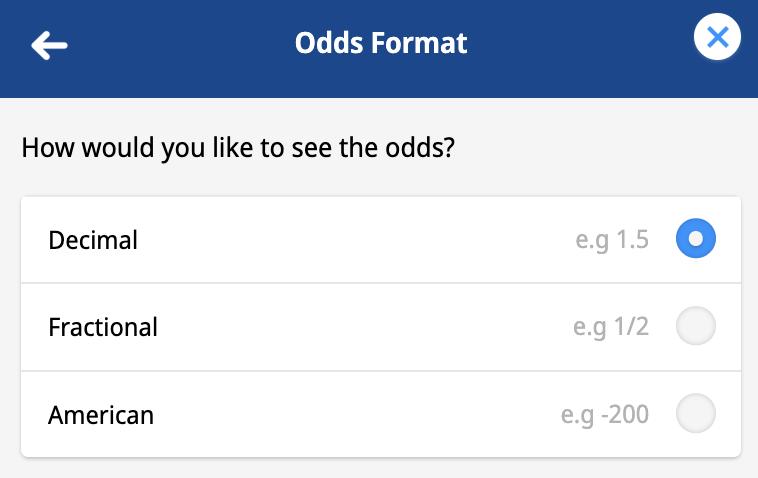
A price of 2.50, 3/2 and +150 can describe exactly the same betting outcome, yet the three numbers look completely different. Someone familiar with decimal odds may understand the first immediately and hesitate over the other two, while a bettor accustomed to American odds may have the opposite experience. The underlying market has not changed; only the way its price is displayed has.
That makes odds format controls a small but important part of a betting platform. International sportsbooks can serve users who follow the same cricket, football, tennis or basketball events but come from markets with different betting conventions. Giving those users a familiar way to read prices reduces unnecessary calculation and allows the interface to adapt without changing the markets themselves.
The Same Odds Can Be Written in Different Ways
Odds formats are different methods of expressing the relationship between a stake and a potential return. Decimal, fractional and American odds use different notation, but one format can be converted into another without changing the underlying price.
Consider a simple example:
| Decimal | Fractional | American |
|---|---|---|
| 1.50 | 1/2 | -200 |
| 2.00 | 1/1 | +100 |
| 2.50 | 3/2 | +150 |
| 3.00 | 2/1 | +200 |
| 5.00 | 4/1 | +400 |
A user who regularly reads decimal prices can compare 1.80 and 2.20 almost instantly. Someone used to fractional odds may find 4/5 and 6/5 equally natural. Neither interface necessarily provides more information; familiarity determines how quickly the information can be interpreted.
This is why forcing every visitor into one notation can add friction that has little to do with the actual betting market.
Decimal Odds Make the Total Return Easy to See
Decimal odds are common across many international betting interfaces because the relationship between stake and total return is relatively direct. A price of 2.40 means that a successful stake of 10 units produces a total return of 24 units, including the original stake.
The calculation is straightforward:
Stake × Decimal Odds = Total Potential Return
That simplicity is useful on mobile screens where users may be comparing several prices quickly. The format also scales neatly from short prices such as 1.20 to much larger values such as 15.00 without changing its basic structure.
For a platform covering international cricket alongside football, tennis and other sports, decimal odds can provide a consistent numerical system across a large catalogue. However, consistency does not automatically mean that every user will prefer it.
Fractional Odds Present Profit Differently
Fractional odds have a long history in British and Irish betting markets. Instead of showing the total return relative to the stake, they traditionally express the potential profit.
At 3/1, for example, a successful stake of £10 would produce £30 in profit, with the original £10 stake returned separately. A shorter price such as 1/2 indicates that the potential profit is smaller than the amount staked.
For someone who has used fractional odds for years, this notation can be immediately understandable. For someone encountering it for the first time, comparing values such as 8/11, 5/6 and 11/10 may require more thought than comparing their decimal equivalents. That difference illustrates why odds display is partly a usability question. A mathematically equivalent format can still create a very different reading experience.
American Odds Use Positive and Negative Prices
American odds introduce another convention. Positive values such as +200 indicate the potential profit on a standard 100-unit stake, while negative values such as -150 indicate how much would need to be staked to make a standard 100-unit profit.
This creates a visual distinction around the +100 and -100 range that is familiar to many users of US-facing sportsbooks. It can be particularly natural when following sports such as basketball, American football or baseball through interfaces built around North American conventions.
For users accustomed to decimal prices, however, switching between +135 and -125 may initially be less intuitive. The reverse is also true: someone who routinely reads American odds may find a long list of decimal numbers less immediately meaningful. A flexible platform does not need to decide which convention is universally better. It can allow the user to decide which representation is easiest to read.
International Sports Make Format Controls More Relevant
Modern betting platforms rarely operate around a single domestic competition. A user can move from an Indian cricket match to English football, an American basketball game and an international tennis tournament within the same session. The sports may be global, but betting conventions are still influenced by geography.
This creates an interesting interface problem. The platform needs a consistent experience even though different groups of users may arrive with different expectations about how odds should look. Automatically changing the notation every time the sport changes would be confusing, while forcing one regional format across the entire platform may be unnecessarily restrictive. A persistent odds format setting solves much of that problem. The sporting content can change while the numerical language remains familiar to the user.
Changing the Format Should Not Change the Market
One of the most important design principles is consistency underneath the display. If a user switches from decimal to fractional odds, the selection itself should remain the same. The market should not reload into a different state, disappear from the bet slip or appear to offer a new price simply because its notation changed.
The conversion is a presentation layer. For example, a selection shown at 2.50 in decimal format might appear as 3/2 after the setting is changed. If the underlying price subsequently moves, both representations should reflect the same update. Keeping that relationship clear prevents a display preference from being mistaken for a market change.
Odds Controls Need to Work Across the Whole Platform
A format selector is much less useful if it changes prices on the event page but leaves other parts of the platform untouched.
Users may encounter odds in many places:
- event and competition pages;
- search results;
- live match interfaces;
- bet slips;
- active bet screens;
- bet history;
- promotional market cards;
- favorites or saved events;
- cash-out and settlement views.
If the user chooses decimal odds, seeing fractional prices appear unexpectedly in another part of the interface creates unnecessary inconsistency. The selected preference should therefore follow the user through the relevant parts of the platform.
This becomes especially important when a bet moves through several stages. The price displayed while browsing should correspond clearly with the price shown when the selection reaches the bet slip and later appears in account history.
Mobile Interfaces Need a Compact Selector
Desktop betting sites can place display preferences inside a sidebar or persistent settings panel. Mobile interfaces have much less space, so odds format controls need to remain accessible without competing with the event itself.
A compact selector can work well when it uses familiar labels such as:
- Decimal
- Fractional
- American
Abbreviations such as DEC, FRA and AME can save space, but only if users can understand them easily. Hiding the setting too deeply inside account preferences creates another problem: users who want to change the format may not know that the option exists. The control does not need to dominate the interface. It simply needs to be discoverable and predictable.
The Selected Format Should Persist
Changing odds format every time a user opens the platform would quickly become irritating. Once a preference has been selected, the interface should ideally remember it where the platform’s account and device settings allow.
Persistence is particularly useful for users who move between different sections frequently. Someone who selects decimal odds before opening a cricket event should not need to choose decimal again when moving to football or returning later to another market.
Cross-device behavior requires more consideration. If the preference is stored only locally, a user may see decimal odds on a phone and fractional odds after logging in on a laptop. If it is associated with the account, the same choice can follow the user more consistently. Neither approach changes the actual market, but predictable settings make the platform easier to learn.
Odds Format Matters When Comparing Several Selections
A single price is relatively easy to inspect in almost any notation. The challenge becomes more noticeable when a page contains dozens of selections.
Imagine a cricket event with markets for match winner, top batter, total runs, wickets, boundaries and individual player performances. Users may scan many prices before opening any one market in detail.
Familiar notation reduces the mental work involved in those comparisons. Someone comfortable with decimal odds can quickly distinguish 1.65, 2.10 and 3.40 without converting them. A fractional-odds user may prefer the same prices expressed in the system they already know.
The advantage is not that one format produces a better comparison. The advantage comes from avoiding conversion while scanning a dense interface.
Live Betting Makes Familiarity Even More Useful
Pre-match markets can remain visible for hours or days, giving users plenty of time to read them. Live markets move at a different pace. Prices may change as the event develops, selections can become temporarily unavailable and new markets can appear. During a cricket match, for example, a wicket or a productive over can alter several prices within a short period.
In that environment, unfamiliar notation adds another layer of interpretation. The user must first understand the number and then understand how it has changed.
A familiar odds format cannot remove the complexity of live markets, but it can remove one unnecessary step. The interface communicates in the numerical convention the user already recognizes.
Format Controls Should Not Be Confused With Odds Movement
Changing 2.00 into 1/1 is not an odds movement. Changing 2.00 into 1.80 is. That distinction needs to remain visually clear.
If switching formats causes large animations, arrows or highlighting similar to those used for price movements, users may interpret a simple display conversion as a market update. The format control should therefore change notation cleanly without borrowing visual signals that normally mean the underlying price has moved.
This separation becomes particularly important in live betting, where genuine odds changes may already be occurring frequently. The interface has two different jobs: show the current price in the preferred notation and separately indicate when the price itself changes.
Potential Returns Can Help Bridge Different Formats
Odds do not need to carry the entire burden of explaining a wager. A clear bet slip can also show the stake and potential return, allowing users to see the practical effect of the selected price.
Suppose a user selects decimal odds of 3.00 and enters a stake of 20 units. Showing a potential total return of 60 provides another layer of context. If the user switches to fractional notation and sees 2/1, the potential return should remain consistent because the underlying price has not changed.
This can be useful when someone is learning a less familiar odds format. They can compare the notation with a concrete stake and return rather than relying on abstract conversion. The platform still needs to distinguish clearly between profit and total return so that the figures are not interpreted incorrectly.
Accessibility Is Also About Reducing Unnecessary Interpretation
Accessibility in betting interfaces is often discussed in terms of font size, contrast, touch targets and screen-reader compatibility. Those areas matter, but cognitive clarity also deserves attention. A user should not need to perform avoidable mental calculations simply because the platform uses a notation unfamiliar to them.
Providing several standard odds formats is a relatively small interface feature that can reduce that burden. Clear labels, stable settings and consistent use across the platform help users understand what they are looking at without adding more information to the screen. This is especially valuable on mobile devices, where attention is already divided among market names, scores, statistics, prices and navigation controls.
Too Many Formats Can Create Their Own Problem
Flexibility does not mean that a platform should offer every possible notation ever used. Most users are likely to need only a small group of widely recognized formats. Adding numerous obscure alternatives can make a simple settings menu harder to understand and test.
A useful format control should therefore prioritize clarity:
| Design choice | Why it matters |
|---|---|
| Use recognizable format names | Users know what they are selecting |
| Keep the setting persistent | Avoids repeated configuration |
| Apply it across relevant screens | Prevents inconsistent prices |
| Separate conversion from price movement | Avoids false signals |
| Keep stake and return figures consistent | Confirms the underlying market is unchanged |
| Make the selector easy to find | Users can correct an unfamiliar default |
The objective is not to turn the interface into an odds-conversion tool. It is to let users choose the numerical language they already understand.
A Small Setting Can Make an International Platform Feel More Familiar
Odds format controls rarely attract the same attention as live statistics, market search, bet builders or cash-out features. They do not create new markets and they do not change what is happening in a sporting event. Their value comes from something simpler.
A betting platform can contain thousands of prices, and every one of those prices has to be interpreted by the person looking at it. When the notation matches that person’s existing habits, reading the interface becomes quicker and more natural. When it does not, even a familiar market can require an extra calculation.
Decimal, fractional and American odds ultimately describe the same underlying information in different ways. Allowing users to choose between them acknowledges that an international audience does not necessarily read that information in the same numerical language. For betting platforms covering global sports, that flexibility can make a large and complicated interface feel noticeably more familiar without changing the markets themselves.